
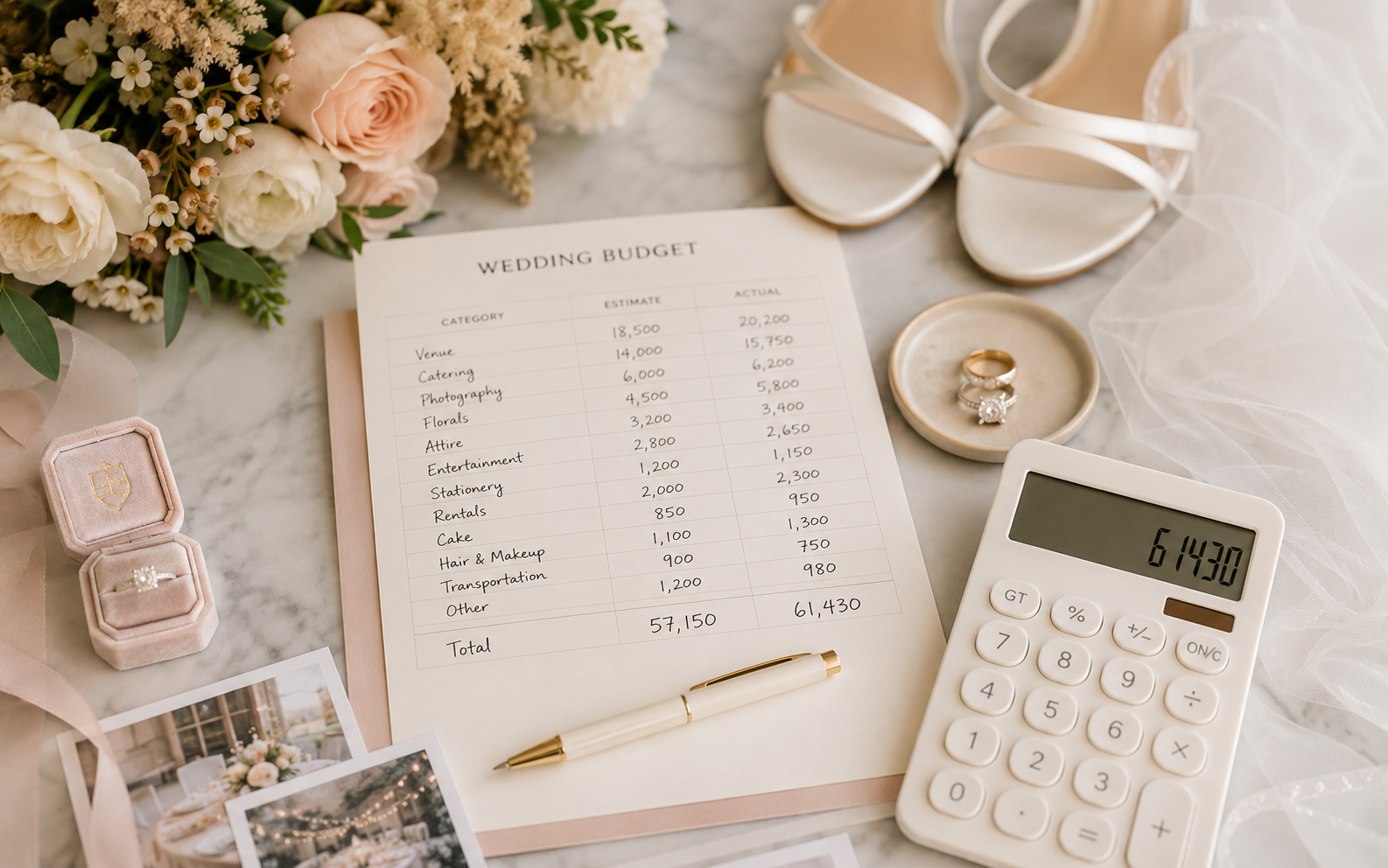
We looked at the newest numbers from more than 20,000 couples. The pattern is not what the magazines say. There is a moment in wedding planning when the celebration stops feeling imaginary.
It usually happens after the champagne has been finished, the ring photos have been posted and you begin emailing venues.
You ask for pricing.
They send back a PDF.
You open it expecting a number and instead discover a venue fee, a food-and-beverage minimum, a service charge, sales tax, ceremony seating, upgraded linens, security, cake-cutting fees and a sentence explaining that gratuity is not included.
Suddenly, the wedding you loosely imagined costing $20,000 appears to cost $20,000 before you have hired a photographer.
This is the part of wedding planning that women tend to whisper about after the fact. Not whether the flowers were beautiful or the dress was worth it, but what everything actually cost once every invoice was paid.
So, what does a wedding cost in 2026?
The honest answer is somewhere between far less than the national average and far more than the first proposal you receive.
The Number Everyone Repeats
The Knot’s 2026 Real Weddings Study surveyed 10,474 American couples who married in 2025 and placed the average wedding cost at $34,200. Zola’s 2026 First Look Report, based on more than 11,500 couples planning 2026 weddings, puts the average at $36,000. (The Knot)
That means the number you will see repeated in headlines is roughly $35,000.
But an average is not a prediction.
A handful of $100,000 weddings can pull the average upward. A courthouse ceremony, a backyard dinner and a 200-person ballroom wedding may all appear in the same national calculation, even though they have almost nothing in common.
The Knot’s own spending groups tell a much more useful story:
● Couples with total budgets of $15,000 or less spent an average of $8,900.
● Couples spending between $15,001 and $40,000 averaged $26,400.
● Couples spending more than $40,000 averaged $70,300. (The Knot)
That is the pattern the glossy averages tend to hide: there is not one normal wedding budget. There are several completely different kinds of weddings being averaged together.
A $12,000 wedding is not necessarily a less successful version of a $60,000 wedding. It is usually a different event—with a different guest count, date, location, vendor list and definition of what matters.
Your Guest List Is Also a Financial Document
The least romantic spreadsheet in wedding planning may be the one that matters most.
Your guest list affects the number of meals, drinks, invitations, tables, chairs, centerpieces, favors, shuttle seats and slices of cake you need. It may also determine whether you can use the venue you love or whether you need a much larger—and more expensive—space.
The Knot reports an average of 117 guests and an average total wedding cost of approximately $292 per guest. Zola’s 2026 survey found a larger average guest count of 145 people, showing how significantly results can vary depending on who is surveyed and which weddings are included. (The Knot)
This does not mean that removing one guest automatically saves exactly $292. Some wedding costs, such as photography and music, stay relatively fixed. But it does mean that guest count is one of the strongest levers you can pull.
Reducing the guest list by twenty people may lower catering, bar and rental expenses. It may also allow you to choose a smaller venue, simplify transportation or move into a different package entirely.
Before choosing your venue, decide which version of your guest list you are actually planning for:
The people we cannot imagine getting married without.
The people we would genuinely love to include.
The people we feel obligated to invite.
Those are three different lists. Your budget may require you to know the difference.
The Venue Price Is Rarely the Venue Price
Venue pricing is one reason couples can receive wildly different answers to a seemingly simple question.
Zola estimates the average venue cost at $8,573 and average catering at $6,927. WeddingWire reports an average venue cost of approximately $6,000, with most couples spending between $3,000 and $11,000. The numbers differ partly because venues package their services differently: one proposal may include tables, staff and catering, while another includes little more than access to the property. (zola.com)
A $7,000 venue that includes tables, chairs, linens, catering equipment and a coordinator may ultimately cost less than a $4,000 venue that requires everything to be rented separately.
When comparing venues, ask each one for the same information:
● The site or rental fee
● Food-and-beverage minimums
● Service charges and taxes
● Tables, chairs, linens and place settings
● Ceremony setup fees
● Required security or valet services
● Approved-vendor restrictions
● Outside-vendor fees
● Overtime charges
● Cleanup and breakdown costs
● Rain-plan expenses
● Required insurance
● Gratuity expectations
Compare the all-in estimated total, not the number printed at the top of the brochure.
The Budget Usually Does Not Break in One Place
Most couples expect the venue, food and photography to be expensive.
What catches them off guard is the accumulation.
It is the dress alterations. The postage. The vendor meals. The welcome sign. The second hair trial. The transportation minimum. The candles that require glass hurricanes. The hotel welcome bags. The breakfast ordered while everyone gets ready. The extra hour of photography. The tips placed into envelopes the week of the wedding.
Zola estimates that service charges, gratuities, overtime and other overlooked expenses can add approximately 9% to 15% beyond the initial vendor quotes. (zola.com)
On a $30,000 wedding, that could mean several thousand dollars that never appeared on the first version of the spreadsheet.
This is why we would not build a $30,000 wedding using all $30,000.
We would plan the visible wedding with approximately 85% to 90% of the available budget and leave the rest untouched for the things that have not introduced themselves yet.
The buffer is not wasted money. It is what allows you to pay the final invoices without feeling as though your wedding has followed you home.
The Wedding Weekend Is Getting Longer
The wedding itself is no longer always one event.
Zola found that 37% of couples are hosting at least one additional gathering, such as a welcome party or post-wedding brunch, while 18% are planning a full two- or three-day wedding weekend. (zola.com)
These events can be meaningful, especially when guests have traveled. They can also quietly create a second catering budget.
A welcome party does not have to be a miniature reception. It can be drinks at a familiar bar, dessert in a hotel courtyard or pizza delivered to a rented house.
A farewell brunch does not have to include floral arrangements and printed menus. It can simply be a suggested meeting place where guests purchase their own breakfast.
Not every gathering needs the visual identity of the wedding. Some of the loveliest moments happen when everyone is allowed to stop performing and sit together.
What Different Budgets Can Realistically Mean
There is no universal formula, but these are useful ways to think about the most common spending levels.
Around $10,000 to $15,000
This budget often works best with a smaller guest list, a restaurant, private home or community venue, a weekday or off-season date and a shorter vendor list.
You may choose photography over videography, a playlist over a full band, personal flowers over elaborate installations or a beautiful dinner instead of a traditional reception.
The decisions need to be intentional, but the wedding does not need to feel unfinished.
Around $20,000 to $35,000
This range is where many couples discover the importance of prioritizing.
You may be able to host a traditional ceremony and reception with professional photography, catering, music and florals—but perhaps not every premium upgrade at the same time.
This is the budget where choosing three things to protect becomes especially helpful.
Maybe yours are the photographer, guest experience and flowers.
Maybe they are the dress, food and live music.
Everything does not need to be equally important.
Around $40,000 to $60,000
This budget may offer more flexibility, but it does not make the trade-offs disappear—particularly in expensive cities or with a large guest list.
Additional events, custom rentals, transportation, full-service planning and elaborate design can move a wedding through this range quickly.
A higher budget does not eliminate the need for a budget. It simply changes the decisions being made.
More Than $60,000
At this level, costs are often being driven by scale, location, design complexity, premium vendors or a multi-event weekend.
The Knot reports that couples in the over-$40,000 category spend an average of approximately $70,300, illustrating just how quickly higher-budget weddings can separate from the national average. (The Knot)
A Note for Georgia Brides
Wedding costs remain deeply regional.
The Knot’s 2026 data places the average Georgia wedding at approximately $29,000, below the national average but still highly dependent on whether the wedding is in metropolitan Atlanta, an affluent suburb, a mountain destination, a coastal location or a smaller town. (The Knot)
A Saturday wedding in Alpharetta, Buckhead or Serenbe may not resemble the statewide average at all.
National numbers are useful for context. Local proposals are what create your real budget.
The Bride to Baby Budget Method
Before booking anything, sit down together and answer four questions.
1. How much can we spend without borrowing?
Begin with the money that already exists or can reasonably be saved before the wedding. Family contributions should only be included after they have been clearly discussed and confirmed.
A wedding budget built around hoped-for money creates stress before the first deposit is due.
2. What are our three priorities?
Choose three things you are willing to spend more on.
Then choose three things you are comfortable simplifying.
This keeps every decision from becoming an isolated emotional emergency.
3. What does this quote cost after everything?
Add service charges, taxes, required rentals, delivery, setup, breakdown and gratuity before comparing vendors.
Never compare one vendor’s starting price with another vendor’s final price.
4. What do we want to remember?
There is a difference between spending for the photograph and spending for the memory.
Invest in the parts you will feel: the people, the vows, the meal, the music, the photographs and the moments when the room feels unmistakably yours.